Posts

Showing posts with the label WinCE

Old Hardware Emulated : Windows Mobile 6.1
Image
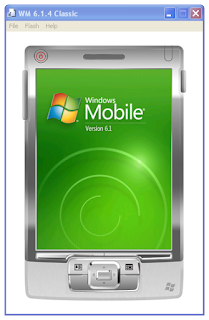
Windows Mobile 6 was a very interesting release, even though not so much in the technical manner. WinMobile 6 was powered by the Windows CE 5 operating system, geared towards PDA's and smartphones. Stability was further improved. The user interface was largely the same, but with a Windows Vista-ish theme applied to it now.  The home screen for Windows Mobile 6.1. The Today program had been installed, providing the Lunar phase illustration next to the LED clock. Using VMware Player 16, my XP VM had two cores allocated to it, along with 3GB's of RAM. The device emulator still wasn't the fastest in the world. This is due to the emulated ARM processor. Code translation would always be a bottleneck. However, this was to be expected, thus, so surprises here. With two cores though, performance of the emulated PDA was significantly improved. Thus, I could actually achieve video playback within Windows Media Player without too much skipping. My sample video was encoded using the WMV...

Old Hardware Emulated - Windows Mobile 5.0

Image
Working title for this post was "But Mama, That's Where The Fun Is!". Appropriate as by the middle 2000's, Windows Mobile was where all the action was at. The sky was only getting brighter for Microsoft as Palm was slowly imploding on itself. With Microsoft's mobile offerings becoming more widespread by the day, the Redmond Giant followed up with the newest version of WM, version 5.0, on May 2005. On the surface, it appears that little changed. However, the biggest change were "under the hood" with the incorporation of the .NET Compact Framework, which is basically the mobile version of .NET. Also, WM 5.0 introduced newer power-saving capabilities which often improved the battery life of devices by as much as 50%. WM backed up everything to flash memory. WinMobile would use a combination of RAM and flash memory to preserve battery life. This wasn't noticeable by the user.  As such, their is no data loss if power is lost.  Windows Media Player was upd...

Old Hardware Emulated - Windows CE.net

Image
Windows CE continued its evolution into different directions. While Windows CE and WinMobile are the same OS, they are package with different user interfaces for their respective markets. Windows Mobile was tailored for PDA's and smartphones while CE "classic" was still tailored for clamshell devices, which were still apparently a thing in 2003. However, their really wasn't much of a clamshell handheld market by this point. As such, most devices that CE 4.2 were destined for served a dedicated, niche role. Microsoft continued to support the clamshell form-factor handhelds with WinCE 4.0, released on January 7, 2002. This latest incarnation of WinCE featured the compact version of the .NET Framework. Also, like most new released, Microsoft released a updated SDK to developers. The SDK, like previous ones, included a device emulator along with various libraries, documentation, and developer tools so that one would become familiar with the platform. The applications were...

Old Hardware Emulated : Windows Mobile 2003 Device Emulator Part 2

Image
  Third Party Apps 3rd Party Programs Running On The Pocket PC 2003 SDK Windows CE had a very decent-sized software library by 2003/2004. The platform was populated by various devices sold by many OEM's. It only made sense for software developers to target the platform. While WinCE's library was never as large as Palm's or J2ME, it was large enough where their users could make worthwhile use of their devices. As mentioned in previous articles, WinCE brought multimedia capabilities to the PDA. Handhelds like the Compaq iPAQ demonstrated that audio and video playback was possible on a small handheld. While the early Sony Clie handhelds running PalmOS had video playback, the video had to be encoded to gray-scale color depth in the PDB format. The video couldn't be that large. You weren't going to be watching that episode of Friends on your Palm anytime soon. While video encoding occurred with WinCE as well, their were far more options and...

Old Hardware Emulated : Windows Mobile 2003 Device Emulator

Image
  Pocket PC 2003 Pocket PC 2003 The PocketPC 2002 device emulator was not one of the easiest to use. The shared folder feature had to be defined manually, along with network configuration. Apparently, many developers were not that amused either. As such, Microsoft greatly improved the user interface of their emulator. Microsoft made shared folders seamless, along with network support. Networking was provided via a driver that was part of Virtual PC, which Microsoft recently acquired from Connectix.  The device emulator operated very differently from this release compared to previous ones. With the CE 2.x SDK's, the "emulator" was actually more of a simulation of the WinCE user interface. The SDK simulator was basically WinCE ported as a runtime that ran directly under Windows. Since it was essentially a Windows application, it conformed to the processor that was used by the host, which in this case, was x86. As such, the SDK simulator could...

Old Hardware Emulated : Pocket PC 2000/2002

Image
  Windows CE On The PDA Pocket PC 2002 starting up. For the remainder of the 90's, Microsoft had a tough time gaining a foothold in the handheld market. Windows CE 2.0 was well received on the palmtop PC's. However, that market-share was small compared to there PDA counterpart that were rocking to the tune of PalmOS. The first incarnation of WinCE on the PDA seemed sparse compared to Palm. At this point, the PDA port of Windows CE was re-branded as Windows Mobile. Around this point, Microsoft's fortunes began to change. For the first time, the Palm platform had that "Oh Crap!" moment when Compaq released the iPAQ in April 2000. The PDA came with the new Windows Pocket PC 2000 operating system. This version of Windows CE was specifically geared towards PDA's in particular. The iPAQ line of PDA's became must own devices for those that wanted the latest and greatest. As how Compaq made IBM look silly in the 80's and 90's...

Old Hardware Emulated : MS SDK's Simulating Windows CE (Part 2)

Image
  Windows CE 2.0 On September 1997, Microsoft released Windows CE 2.0. There have been many improvements made in this version as the Redmond Giant received plenty of feedback from the users that tried CE 1.0. Most of these changes made have been within the realm of usability and making the WinCE devices more usable with a typical consumer. Like Pegasus and CE 1.0, 2.0 was largely geared towards the HPC handheld devices. HPC, or handheld PC, were a form of palmtop/clamshell computers made by various companies like Sharp, Casio, NEC, and HP. The new version of Windows CE was very well received on these devices.  Like Palm and Apple, Microsoft released a SDK for software developers to write WinCE specific applications. These kits included device simulators that allowed developers to test there applications without needing a actual device. Again, this isn't that different from what Palm was doing at the time. However, at this point, it should be noted at a s...

Old Hardware Emulated : MS SDK's Simulating Windows CE (Part 1)

Image
  Establishing Context There is one thing that we need to get out of the way..........Microsoft didn't create WinCE as a response to the success of the Palm Pilot. The research that would eventually result in WinCE was several years in the making. Microsoft was doing it's own research into handheld operating system independently of Apple and Palm Computing. In The Beginning In 1989, Atari released the Portfolio, which was a handheld palmtop/clamshell PC. Yes, this was a actual handheld PC as the portable computer was literally a IBM PC/XT Compatible PC. The machine had a CMOS variant of the Intel 8088 Processor running at 5MHz, along with 128KB of RAM, and a 240 by 64 pixel LCD display capable of a 40 by 8 character display. The Portfolio had MS-DOS 2.11 in ROM. The Portfolio had a retail price of $400 in 1989, which is the equivalent of $824 in 2019. The Portfolio showed the limitations of a PC environment on a handheld device. MS-DOS,...